LapBrain breaks every corner into five phases. Understanding these phases helps you read your corner analysis and act on recommendations.
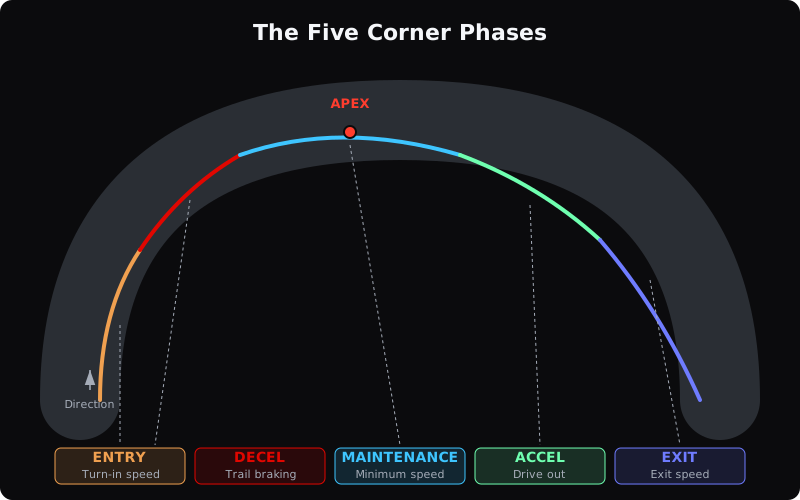
The five phases
Entry
The Entry phaseEntry phaseThe initial part of a turn where the bike transitions from straight-line travel into the corner, typically involving braking and the beginning of lean. begins when you start turning into the corner. At this point you're transitioning from straight-line riding to cornering. LapBrain measures your entry speed — how fast you're going as you begin the turn.
What matters here: Carrying appropriate speed into the corner. Too slow wastes time; too fast forces a correction mid-corner.
Decel (Deceleration)
The decel phase is where you're actively slowing down while turning. This is where Trail brakingTrail brakingMaintaining brake pressure while leaning into a corner, loading the front tire and tightening the turning arc. happens — maintaining brake pressure while leaning into the corner.
What matters here: Braking distanceBraking distanceThe arc distance from your braking point to the apex of the corner. Shorter braking distances mean later braking and a more committed entry. and deceleration rate. A shorter, later braking zone (done safely) means higher average speed through the corner.
Maintenance
The Maintenance phaseMaintenance phaseThe middle portion of a turn where speed is roughly constant, between the end of deceleration and the start of acceleration. is the tightest part of the turn — near-constant speed between braking and acceleration. Your speed is at its lowest near the ApexApexThe point in a corner where the bike is closest to the inside edge of the track and typically at the lowest speed. .
What matters here: Smoothness and minimum speed. A smooth maintenance phase sets up a strong exit.
Accel (Acceleration)
The accel phase begins when you start opening the throttle after the apex. LapBrain measures your drive — how effectively you convert from cornering back to acceleration.
What matters here: Getting on the throttle early and progressively. The earlier you can begin accelerating (without running wide), the faster you'll be down the next straight.
Exit
The Exit phaseExit phaseThe final part of a turn where the bike transitions from cornering back to straight-line travel, approaching full throttle. is where the corner ends and you're straightening the motorcycle. LapBrain measures your exit speed and exit drive ratio — how much speed you're carrying out relative to what's possible.
What matters here: Exit speed directly determines straight-line speed. A strong exit phase is often worth more than a fast entry.
Why phases matter
Each phase has distinct techniques and distinct failure modes. A rider who brakes well but picks up the throttle too early has a decel strength but an accel weakness. By breaking corners into phases, LapBrain pinpoints exactly which technique to work on — not just "this corner is slow."
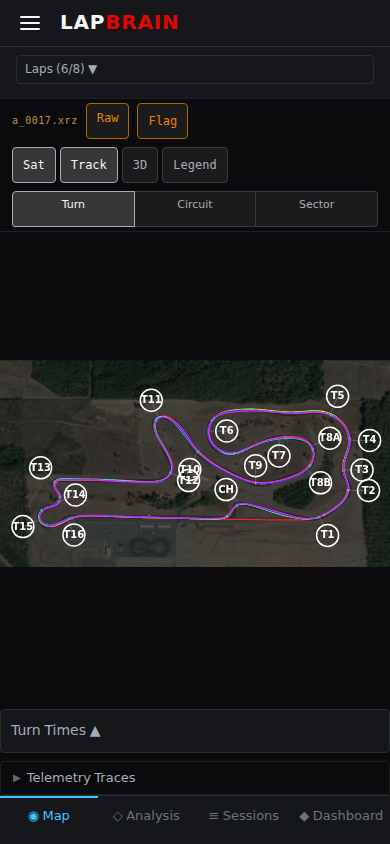
When reviewing a corner in the app, look at the colored phase segments on the corner trace. Tap any phase to see its metrics. The longest bar isn't always the problem — sometimes a short maintenance phase (fast through the apex) creates an exit problem downstream.
Reading phase data in the app
In the corner detail view, each phase is shown as a colored segment on the corner trace. The metrics table shows:
- Maintenance time — how long you spent at minimum speed
- Entry/Exit speed — speed at the start and end of the corner
- Min speed — your lowest speed near the apex
- Braking distance — how far you braked while turning
- Exit drive ratio — acceleration effectiveness out of the corner
What to do next
- Open a corner detail — tap any corner on your track map and look at the five phase segments.
- Compare your best and worst laps — where do the phases differ? The phase with the biggest gap between laps is usually the highest-value area to improve.
- Read Understanding Coaching to learn how to turn phase data into on-track action.